
MOIT VIETNAM | Strengthening Business Connectivity and Promoting Vietnam–Laos Trade
/ News
Strengthening Business Connectivity and Promoting Vietnam–Laos Trade
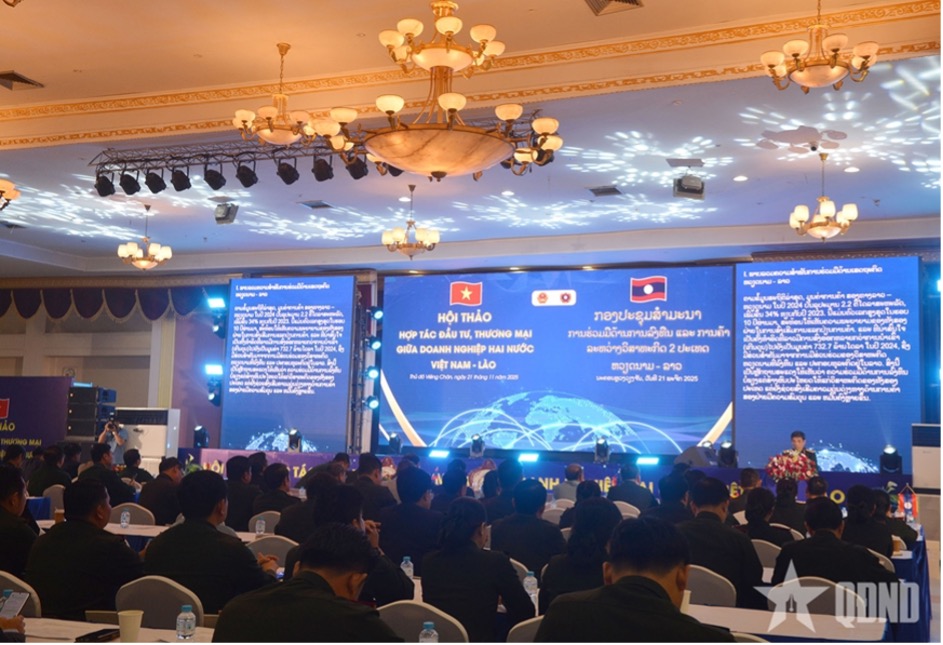
Laos is a market that is geographically close to and culturally similar to Viet Nam; however, Vietnamese goods imported into Laos still face intense competitive pressure. Which sectors, then, hold the greatest potential for Vietnamese products to penetrate the Lao market, and what are the real “bottlenecks” that need to be addressed? These questions were partly answered at the seminar entitled “Investment and Trade Cooperation between Vietnamese and Lao Enterprises,” held on November 21 at the Lao International Trade Exhibition and Convention Center (Lao ITECC) in Vientiane.
A solid foundation
The seminar was an activity within the framework of the 2025 Vietnam–Laos Trade Connectivity and Product Promotion Fair, aiming to concretize the policy of economic–defense cooperation, build trade bridges, and expand investment opportunities for the business communities of both countries.
At the seminar, participants were provided with an overview of the investment situation and economic cooperation of Vietnamese enterprises in Laos, Lao policies supporting investment and trade, and assessments of the potential for investment and business cooperation between enterprises of the two countries. In particular, the seminar analyzed the potential, challenges, and opportunities for Vietnamese goods in the Lao market. In addition, a discussion session was held in which agencies, units, and enterprises from both countries proposed and recommended solutions to create more favorable conditions for the development of businesses in Viet Nam and Laos.
Sharing at the seminar, Major General Đào Minh Đạo, Deputy Director of the Department of Finance under the Ministry of National Defence of Viet Nam, affirmed that Laos has always been identified as a strategic partner and an important market for Vietnamese enterprises. The two countries share a contiguous geographical position, with a common border of more than 2,300 km running through 10 provinces on each side, connected along the East–West Economic Corridor. Geographic proximity, similarities in culture and consumer habits, and mutually preferential policy frameworks are major advantages for effective cooperation between enterprises of the two countries. From a strategic perspective, Laos also serves as a gateway for Vietnamese enterprises to expand into the ASEAN domestic market and connect with third countries.
According to the latest statistics, bilateral trade turnover between Viet Nam and Laos in 2024 reached approximately USD 2.2 billion, an increase of nearly 34% compared to 2023. By the end of 2025, bilateral trade turnover is expected to reach USD 3.5 billion, a record figure over the past decade, reflecting the strong efforts of both sides to promote trade exchanges.
These achievements have been significantly contributed to by military enterprises of both countries. Since previous decades, alongside their defense missions, military units of the two countries have proactively participated in production and economic development activities in border areas and remote regions of Laos—places where the imprint of Vietnam–Laos friendship has been deeply engraved through each project, plantation, and factory.
Vietnamese military enterprises investing in Laos not only play the role of investors and economic partners but also fulfill a political mission as bridges of solidarity between the two countries. Currently, many Vietnamese military enterprises are implementing projects in Laos, notably the Military Industry and Telecommunications Group (Viettel), the General Corporation for Economic Cooperation of Military Region 4, and the Military Commercial Joint Stock Bank (MB). It can be said that each project of Vietnamese military enterprises in Laos serves as an “economic ambassador,” contributing to Viet Nam’s reputation and positive image in the host country.
Joining hands to remove difficulties
Alongside these impressive results, it must be frankly acknowledged that Vietnam–Laos economic relations have not yet fully matched the potential and the special relationship between the two countries. Bilateral trade turnover currently accounts for only about 10% of Laos’s total foreign trade and 0.2% of Viet Nam’s. Investment by Vietnamese enterprises in Laos has shown signs of rebounding in a more sustainable direction; however, Viet Nam still ranks only third among the largest investors in Laos, after China and Thailand.
Commenting on the challenges affecting Vietnam–Laos economic, trade, and investment cooperation, Mr. Mouavixay Palee, Deputy Director General of the Department of Foreign Trade under the Lao Ministry of Industry and Commerce, stated that although Laos and Viet Nam have signed a Trade Agreement and a Border Trade Agreement, implementation procedures in both countries remain complicated. In addition, transport infrastructure between Viet Nam and Laos still faces many difficulties.
To address these issues and realize the goal of raising Vietnam–Laos trade turnover to USD 5 billion in the coming years, the governments of the two countries are implementing a series of synchronized measures: actively removing institutional and policy barriers; signing new-generation bilateral trade and border trade agreements; encouraging the use of local currencies in payments; upgrading logistics infrastructure and border gates; and more. Recently, the two governments have agreed on several important policies, such as agreements on coal and electricity trading, as well as pilot programs for using the two countries’ local currencies (VND and LAK) in bilateral trade transactions. These steps create a favorable legal foundation for promoting energy and trade cooperation in the coming period and will help make bilateral trade activities more convenient, safe, and efficient in the near future.
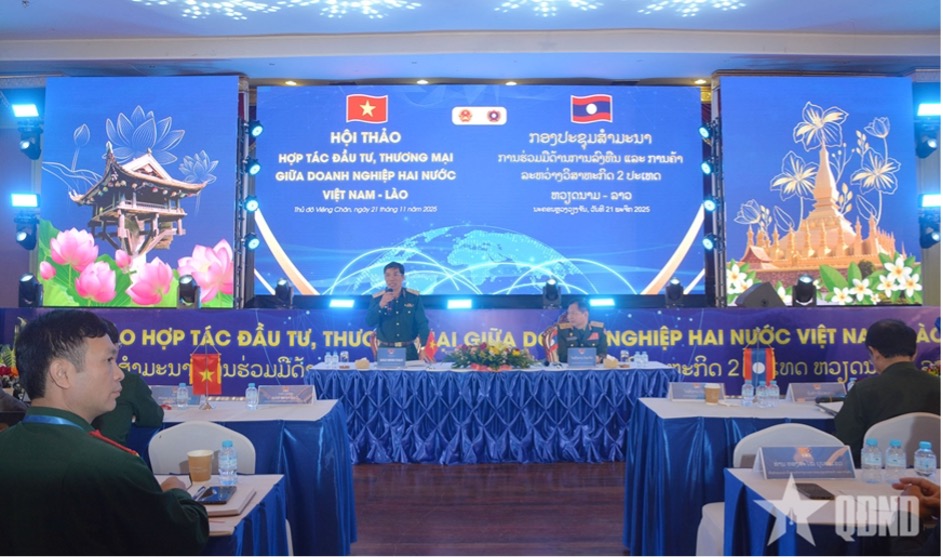
Further elaborating on this issue, Major General Xaysongkham Vorachith, Director General of the Department of Economy under the Lao Ministry of National Defence, said that the Lao Government places special emphasis on investment promotion and continuously improves the investment environment toward greater convenience, transparency, fairness, and the protection of investors’ legitimate rights. Administrative services are centralized through a one-stop investment service mechanism to simplify procedures and shorten processing time. At the same time, the Government has issued preferential tax policies and encourages land-use allocation for priority sectors such as agriculture, technology, education, and tourism, as well as for key development areas—particularly regions with economic development potential along the North–South and East–West axes—in order to promote connectivity and integration.
It is also noted that Viet Nam and Laos have closely coordinated in implementing strategic infrastructure connectivity projects to help Laos gradually “gain access to the sea” and integrate internationally. Key projects include joint investment in berths 1, 2, and 3 at Vũng Áng Port. These projects are of regional multimodal transport significance, promising to open up new development space and elevate bilateral economic relations to a new level.
The journey to conquer the Lao market
With 22 years of experience closely associated with the Lao market, Mr. Khounkham Souvannalath, a Vietnamese-origin Lao national and currently Vice Chairman of the Association of Vietnamese Businesses in Laos (AVILA), shared insights into the opportunities and challenges facing Vietnamese goods in Laos. According to him, challenges for Vietnamese products include Lao consumers’ preference for Thai goods, initial prejudices regarding the quality of Vietnamese products, high transportation costs that reduce price competitiveness, and challenges arising from the rapid rise of Chinese goods.
Nevertheless, the Lao market still holds significant potential opportunities for Vietnamese products. First and foremost, the quality of many Vietnamese products today is fully comparable to that of Thai goods, while being offered at more reasonable prices. This is the sharpest competitive advantage of Vietnamese goods. In addition, policy incentives, support from the governments of both countries, and the network of Vietnamese businesses in Laos also play an important role in bringing Vietnamese products closer to Lao consumers.
At the seminar, Mr. Khounkham Souvannalath proposed five core solutions for Vietnamese goods to succeed in the “Land of a Million Elephants”: building a systematic distribution strategy; localizing products; allocating reasonable budgets for marketing; fostering close cooperation between manufacturers and distributors; and securing support from the Government of Viet Nam. He expressed his hope that the Government would continue to further facilitate tax refund and value-added tax deduction procedures for goods exported to Laos, helping enterprises reduce financial burdens.
From an entrepreneur’s perspective, Mr. Khounkham Souvannalath assessed that golden opportunities are widely opening up for Vietnamese goods. A deep understanding of the market and the ability to seize opportunities will help Vietnamese products go further on their journey to conquer the Lao market.
-
/ News
Vietnam-Laos Investment Cooperation: Expectations for a 10 Billion USD Breakthrough
A series of major Vietnamese investment projects in Laos and the development of industrial linkage chains are expected to yield practical results, ...
-
/ News
Bringing Vietnam-Laos Cooperation into Depth, Substance, and Greater Sustainability
-
/ News
Increasing Numbers of Vietnamese Business Projects Operate Effectively, Making Positive Contributions to Lao Socio-Economic Development Across All Sectors
As part of the working program in Laos to co-chair the 48th Session of the Intergovernmental Committee on Vietnam-Laos Bilateral Cooperation, Prime...