
MOIT VIETNAM | Strengthening Connectivity Between the Vietnamese and Lao Economies
/ News
Strengthening Connectivity Between the Vietnamese and Lao Economies
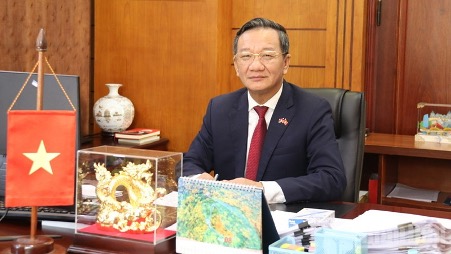
On the eve of upcoming working visits to Laos by General Secretary Tô Lâm and Prime Minister Phạm Minh Chính, Vietnamese Ambassador to Laos Nguyễn Minh Tâm spoke with a correspondent of Nhân Dân Newspaper about the highlights of economic relations between the two countries and efforts to strengthen connectivity between their economies.
Reporter: Could you highlight the bright spots in Vietnam–Laos economic relations and some effective cooperation models in recent years?
Ambassador Nguyễn Minh Tâm:
In recent years, thanks to the strong direction and close attention of senior leaders, as well as the active participation of ministries, sectors, and enterprises of both countries, Vietnam–Laos economic and trade cooperation has continued to maintain strong growth momentum with many notable highlights.
In terms of investment cooperation, Vietnamese enterprises operating in Laos have generally made positive contributions to socio-economic development, creating jobs and improving incomes for thousands of workers, while also supplementing revenue for the Lao state budget. Beyond investment activities, Vietnamese enterprises have fulfilled their corporate social responsibility through various social welfare initiatives in Laos.
Notably, an increasing number of major Vietnamese corporations with strong capacity and professional governance have been conducting in-depth market research and making well-structured investments in Laos. The presence of these leading enterprises not only creates strong spillover effects but also provides guidance, momentum, and confidence for the broader Vietnamese business community in Laos—especially small and medium-sized enterprises—thereby enhancing the overall effectiveness of investment, production, and business activities.
Typical examples include: Nam Laos Agriculture Investment and Production One-Member Limited Liability Company implementing a smart agriculture project applying high technology across production and processing stages, forming a modern agricultural value chain in Attapeu Province; Viet Phuong Group investing in factories to enhance the value added of minerals in Sekong Province; and Viet–Lao Energy Joint Stock Company implementing wind power projects in Bolikhamxay Province to supplement clean and stable energy sources for domestic use and export.
In addition, major groups and corporations such as Vietnam Airlines and BIM Group have made systematic investments in civil aviation and the development of modern hotel and resort projects, contributing to the promotion and development of Laos’s tourism sector. Star Telecom (Unitel), in cooperation with Viettel Post, has been building and developing logistics systems in Laos.
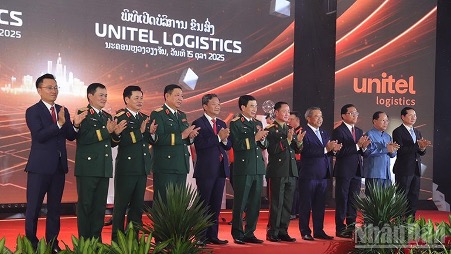
These models have been implemented in a structured manner, aligned with the Lao Government’s policies toward a green, circular, and sustainable economy, thereby enhancing the efficiency, quality, and added value of bilateral economic relations.
With the highly positive initial results achieved, I believe these investment models will help shape, guide, and spread best practices, eventually being widely applied across Laos.
Alongside investment, bilateral trade between Vietnam and Laos has also recorded impressive growth. During the 2020–2024 period, bilateral trade grew at an average rate of 9.7% per year. In 2024, trade turnover reached USD 2.25 billion, up 38.2% from 2023—marking the first time bilateral trade exceeded the USD 2 billion threshold. In the first ten months of 2025 alone, trade turnover reached approximately USD 2.5 billion, up 50.4% year-on-year.
This impressive growth reflects the strong momentum of bilateral trade cooperation and the robust recovery of supply chains between the two countries and the region. On this basis, the targets of reaching USD 5 billion in bilateral trade within the next few years and USD 10 billion by 2030 are well grounded.
Overall, these achievements have laid a solid foundation for Vietnam–Laos economic cooperation to continue developing strongly and sustainably. With the political determination of the leaders of both Parties and States, together with the efforts, dynamism, and creativity of the Vietnamese business community, I believe that economic cooperation in general—and cooperation between enterprises of the two countries in particular—will continue to deepen, making tangible contributions to the socio-economic development of both nations and further nurturing the great friendship and special solidarity between Vietnam and Laos forever green and enduring.
Reporter: What is the role and significance of promoting integration and connectivity between the Vietnamese and Lao economies in strengthening and developing bilateral relations?
Ambassador Nguyễn Minh Tâm:
Vietnam and Laos share a common border of more than 2,337 km, running through 10 provinces and cities of Laos and 9 provinces and cities of Vietnam. These areas lie along the East–West economic corridors, possess strong development potential, and serve as gateways connecting the two countries with ASEAN and the world. Promoting economic connectivity in these regions helps fully leverage locational advantages, expand trade, improve livelihoods, raise living standards, and foster rural and mountainous development as well as socio-economic progress in border areas.
In recent years, to increase bilateral trade turnover, the two sides have implemented various measures, including signing the Bilateral Trade Agreement (March 3, 2015; amended and re-signed on April 8, 2024), the Border Trade Agreement (June 27, 2015), and most recently the Vietnam–Laos Agreement on Coal and Power Trading (January 9, 2025). They have also coordinated numerous trade promotion activities, business connectivity programs, fairs, seminars, and trade-matching events, providing enterprises with opportunities to showcase products, negotiate contracts, and expand distribution networks.
In addition, relevant ministries and sectors have signed new or amended agreements to support increased trade. These legal frameworks provide practical facilitation for enterprises of both countries to exchange goods and promote the growing development of bilateral and border trade.
Transport infrastructure connectivity plays a particularly important role in creating breakthroughs in economic cooperation. In recent years, senior leaders of both countries have directed the implementation of strategic projects such as the Hanoi–Vientiane expressway, routes along the East–West economic corridors, and key border-gate connecting roads. Once completed, these projects will shorten transport times, reduce logistics costs, enhance market access, and create favorable conditions for industrial clusters and economic zones along the routes, thereby increasing value added and developing logistics services.
Moreover, with its maritime economic potential, Vietnam has supported Laos in accessing the sea through cooperation in developing berths No. 1, 2, and 3 at Vũng Áng Port, enabling Laos to quickly access ASEAN and global markets and transforming it from a “landlocked country” into a “land-linked country.”
Alongside transport connectivity, banking and financial connectivity plays a crucial role and needs to move one step ahead. On January 9, 2025, the State Bank of Vietnam and the Bank of the Lao PDR announced the Vietnam–Laos Local Currency Payment Framework and bilateral QR-code retail payment connectivity, allowing enterprises and individuals to use local currencies (VND/LAK) for payments, remittances, and investments without intermediary foreign currencies. This reduces conversion costs and exchange-rate risks, facilitates trade, investment, and border commerce, and significantly deepens economic and financial connectivity.
Beyond these areas, central and local authorities of both countries are actively promoting connectivity in other key fields such as energy, services, tourism, digital connectivity and digital transformation, education and labor, and institutional and policy coordination.
It can be affirmed that promoting economic integration and connectivity between Vietnam and Laos not only brings tangible socio-economic benefits and improves people’s material and spiritual lives, but also serves as a strategic pillar in strengthening, elevating, and sustaining the special relationship between the two countries, contributing to stability, peace, friendship, and shared development in the region.
Reporter: What solutions do you propose to further connect the two economies in the coming period?
Ambassador Nguyễn Minh Tâm:
In the new phase, both Vietnam and Laos demonstrate strong political determination to make economic, trade, investment, and infrastructure cooperation a strategic pillar binding their special relationship. To realize this goal, the two sides should focus on two major solution groups: institutional–policy connectivity and infrastructure–logistics connectivity.
First, regarding institutional and policy connectivity, both sides should continue to improve and upgrade the legal framework. Reviewing, supplementing, and supervising the implementation of signed agreements will help create a stable, transparent, and synchronized environment for enterprises. The two countries are also promoting a Vietnam–Laos Cross-Border Economic Cooperation Agreement to establish a modern legal corridor supporting trade and investment and facilitating the development of production–consumption value chains.
Another important solution is strengthening coordination at the government level. Establishing a Vietnam–Laos Economic Connectivity Steering Committee would help unify direction, promptly address bottlenecks, and accelerate strategic projects. At the same time, both sides will speed up the reform of aid mechanisms toward greater depth, effectiveness, and clear criteria to ensure sustainable cooperation projects.
Regarding administrative reform, it is necessary to further decentralize authority to border provinces and simplify import–export, customs, goods control, and immigration procedures to maximize facilitation of cross-border trade. The two countries are also coordinating to build inter-agency coordination mechanisms for licensing and implementing investment projects, and to establish a joint task force on investment and trade to resolve obstacles facing major projects.
Financial and banking connectivity plays a key role in economic integration. Both sides are actively implementing the ACCD model to promote the use of local currencies (VND/LAK), expand cross-border QR payments, establish flexible credit mechanisms (VND loans repaid in LAK and vice versa), and develop digital finance infrastructure, fintech, and payment system connectivity with ASEAN—thereby promoting trade, tourism, investment, and capital flow security.
Second, regarding infrastructure and logistics connectivity, the top priority is accelerating strategic projects that create “breakthroughs in development space.” Key projects include the Hanoi–Vientiane expressway, envisioned as a strategic link between northern and north-central Vietnam and Laos, promoting socio-economic development, border trade, tourism, logistics, and international connectivity.
The Vientiane–Vũng Áng railway project is another key growth axis, creating a direct import–export corridor for Laos to the sea while sustainably connecting Vietnam and Laos with the region.
Regarding seaports and logistics systems, bringing berth No. 3 of Vũng Áng Port into operation is a major milestone in realizing the strategy of “bringing Laos to the sea.” Both countries will also upgrade logistics capacity at Vũng Áng, Hòn La, Xuân Hải, and Mỹ Thủy ports, while developing logistics zones and bonded warehouses along the East–West economic corridors.
In terms of energy and industrial connectivity, both sides have agreed to accelerate power transmission projects from northern Laos to Vietnam, cooperate in power and coal trading, and prioritize the development of Vietnam–Laos industrial parks, border economic zones, and logistics service centers.
For tourism and the digital economy, efforts will focus on expanding shared tourism corridors, building cross-border e-commerce platforms, and developing digital services, renewable energy, and high-tech agriculture to create added value and spillover effects.
With strong political determination and a synchronized approach combining institutional–policy and infrastructure–logistics connectivity, Vietnam and Laos are well positioned to achieve a strategic breakthrough in connecting their economies. This will not only support the target of USD 5 billion in bilateral trade in the coming years and USD 10 billion by 2030, but more importantly contribute to the formation of a shared, stable, and sustainable development space commensurate with the special Vietnam–Laos relationship in the new era.
-
/ News
Vietnam-Laos Investment Cooperation: Expectations for a 10 Billion USD Breakthrough
A series of major Vietnamese investment projects in Laos and the development of industrial linkage chains are expected to yield practical results, ...
-
/ News
Bringing Vietnam-Laos Cooperation into Depth, Substance, and Greater Sustainability
-
/ News
Increasing Numbers of Vietnamese Business Projects Operate Effectively, Making Positive Contributions to Lao Socio-Economic Development Across All Sectors
As part of the working program in Laos to co-chair the 48th Session of the Intergovernmental Committee on Vietnam-Laos Bilateral Cooperation, Prime...